
In 2026, four years after the dramatic heist that first catapulted the name Kay Vess into the galactic underworld, players still find themselves drawn back to the dusty cantinas and starlit skies of Star Wars Outlaws. The game, set in the narrow window between The Empire Strikes Back and Return of the Jedi, captures a peculiar moment in galactic history. While the Rebellion and the Empire clash in battles that dominate headlines, the real story unfolds in the shadows. Here, criminal syndicates like the Crimson Dawn, the Hutts, and the Pykes carve out empires of their own, and a clever scoundrel can make a name for herself with nothing more than a blaster, a stolen ship, and a small, furry companion.
Kay Vess wasn't born into this life. The glittering casinos of Canto Bight on Cantonica were her childhood playground, but the city's polished surface always concealed a predatory core. By the time she became the hunted, with a Death Mark hung over her head by the chilling leader of the Zerek Besh syndicate, Sliro, Kay had already learned that trust is a luxury few can afford. A failed heist turned her into a target, and the only way out was a job offered by the enigmatic Jaylen: steal 157 million credits in unmarked beskar ingots. It was a classic heist-movie setup, shot through with the galaxy's particular brand of dusty hope. What followed was a journey that mirrored the classic scoundrel's arc—full of shifting allegiances, unexpected betrayals, and the constant question of whether honor among thieves was anything more than a comforting myth.
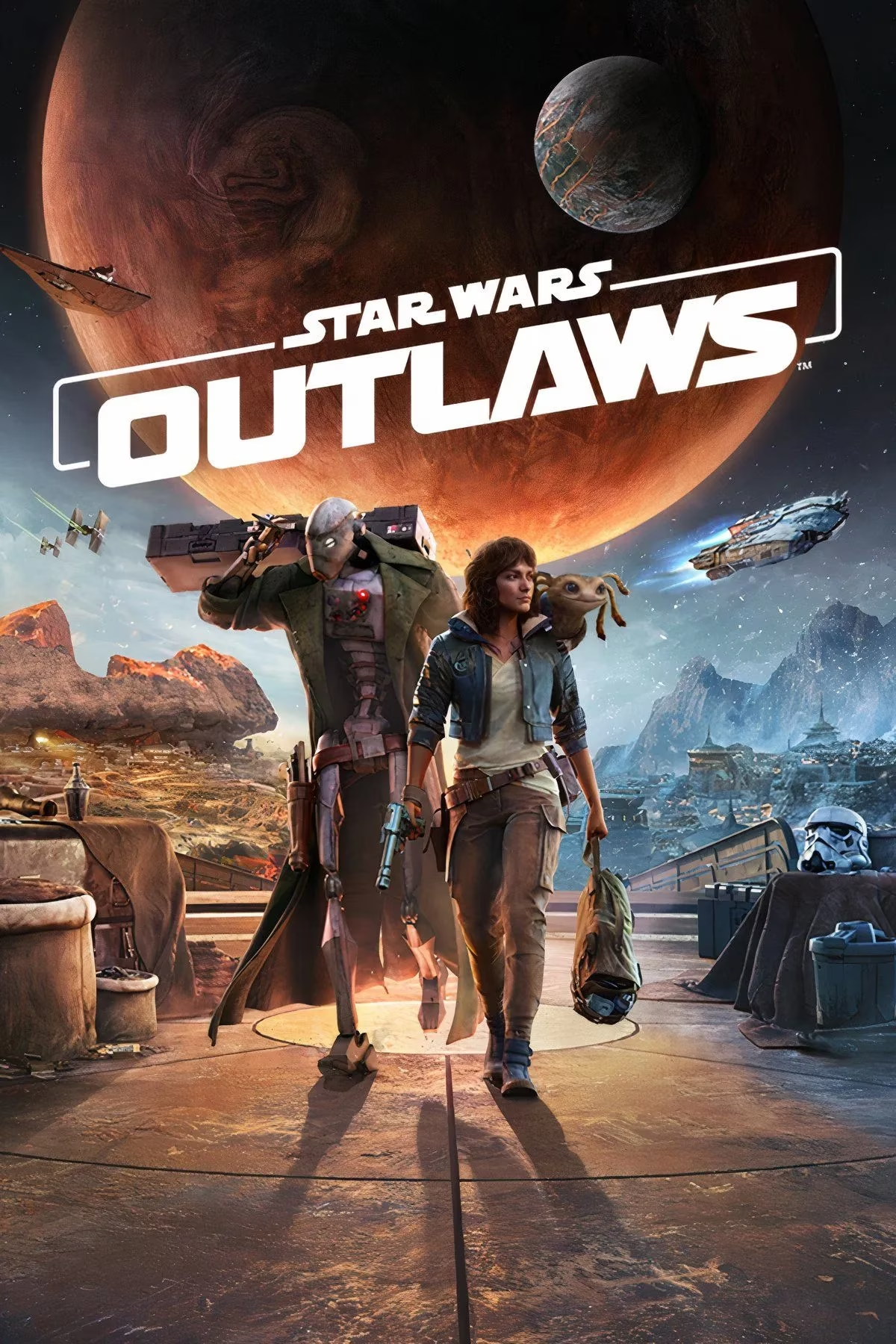
From the moment Kay stepped off Canto Bight, her story became a fragmented trail of ship upgrades, whispered code phrases, and reluctant alliances. To pull off the heist, she needed a crew—an explosive expert, a droidmaster, a slicer who could talk their way past any security lock. Gathering them meant crisscrossing the Outer Rim, from the iconic twin suns of Tatooine to the lush, savannah moon of Toshara, a new world rendered with such fidelity by Massive Entertainment that every trembling grass stalk and weathered settlement felt lived-in. Tatooine remained a faithful recreation of the backwater planet, complete with Jabba’s palace where a carbonite-encased Han Solo already hung on the wall, a silent tribute to the overlapping canon. Even references to Qi’ra and the Syndicate Wars, pulled straight from the Crimson Reign comics, reminded players that this was not a standalone adventure but a vital thread in the vast tapestry of Star Wars lore.
Yet the heart of the experience wasn't the galaxy-shaking revelations, at least not at first. It was the minute-by-minute rhythms of a scoundrel’s life. Kay’s skills didn’t grow through traditional skill trees; she improved by doing. Pulling off headshots with her blaster, sending Nix to pick a guard’s pocket, or surviving an ambush by the Pykes’ death squads—all of it fed into a progression system that felt organic, as if Kay was truly learning the tricks of the trade. Her blaster work carried the snappy feedback of Massive's own The Division, while the fluid cover-to-cover movement echoed the cinematic gunplay of Uncharted. But brute force was rarely the best answer. Stealth remained the preferred language of the thief, and here Star Wars Outlaws borrowed freely from Ubisoft's deep catalog. Tall grass hid Kay like an Assassin, steam vents provided industrial concealment, and her electrobinoculars, reminiscent of Far Cry's, let her tag enemies and plan routes with patient precision. The true star was Nix, a small Merqaal with a big role. He could deactivate alarms, open sealed doors, and distract guards—a furry embodiment of the hacking mechanics from Watch Dogs—and when a mission temporarily took him away, the silence felt suffocating, every locked door and patrolling stormtrooper a reminder of how incomplete Kay was without him.
The syndicate system layered additional tension onto every decision. Favors to the Crimson Dawn might win access to restricted gear and safe houses, but they could also earn the murderous enmity of the Pykes. In one playthrough, a player who had eagerly devoured the comics and longed to see the Dawn's inner workings cultivated an “Excellent” reputation with them, only to find themselves ambushed by Pyke death squads at the most inconvenient moments, their reputation sunk to the lowest rung. This balancing act felt like Splinter Cell: Double Agent reimagined for a galaxy of hutts and spice runners, where no choice was without cost.
Transportation offered its own joys. Kay’s landspeeder handled with a weighty responsiveness, perfect for racing across Toshara’s plains or the dunes of Tatooine, pulling off stunt jumps that scattered gundarks and jawas alike. But the crown jewel was the Trailblazer, Kay’s starship. Space combat felt intuitive, with a smooth lock-on system and a maneuverability that turned dogfights with TIE fighters into ballets of laser fire. Transitioning from a planet’s surface to the void of space was seamless, a loading screen masquerading as a journey, and the result was a galaxy that felt connected in a way procedurally generated expanses never could. It was pared back, yes—only five hand-crafted planets compared to a universe of procedurally scattered rocks—but each one brimmed with life, from cantina card games to the thunder of fathier races.
The journey was not without its quiet frustrations. The need to hunt down specific ship components sometimes slowed the story’s momentum, forcing Kay to linger on Toshara or wait out a Tatooine lockdown when the wider narrative begged for flight. During the main campaign, the “open world” occasionally felt hemmed in, a series of necessary detours rather than a playground of pure freedom. It was only after the credits rolled, after the last twist of the heist had been revealed and the final betrayals had played out, that the galaxy truly opened its arms. Then, the full scoundrel’s life emerged: exploring forgotten corners, maxing out reputations, and taking on bounties without the pressure of the main story pressing down.
Still, even with its pacing wobbles, Star Wars Outlaws endures as a singular window into the grime and glory of the galactic fringe. It’s a game that smells of ozone and engine grease, where every cantina backroom holds a secret and every ally might be sizing up the bounty on your head. For those who first stepped into Kay’s boots in 2024, returning in 2026 feels like coming home to a beloved underworld. The consequences of Kay’s story have yet to fully ripple through the broader canon, but one thing is certain: this scoundrel's first adventure was an excellent one, and the galaxy is richer for it.