
In the sprawling and often unforgiving galaxy of the games industry, few journeys are as tumultuous as that of a blockbuster with a spluttering hyperdrive. By the autumn of 2024, Ubisoft's ambitious open-world scoundrel sim, Star Wars Outlaws, found itself drifting through a nebula of unmet expectations. Sales had been, in the publisher's own admission, "softer than expected," and second-quarter financial results fell short of internal targets. The narrative had become one of a flawed jewel, a game that had captured the aesthetic of the Outer Rim but had apparently struggled to engage players with its stealth, combat, and moment-to-moment loops. Yet, even as critics like Eurogamer's Chris Tapsell lamented a fundamental lack of polish and cohesion—comparing it unfavourably to the Arkham series, Dishonored, and even Ubisoft's own Assassin's Creed—the team at Massive Entertainment did not retreat. Instead, they plotted a course correction that would lean heavily on the charm of a galaxy's most notorious gambler and the cold reality of the Steam storefront's vast user base.
The first major salvo in this fight for relevance was announced with a title that spoke directly to the game's core DNA: Wild Card. Set to launch on 21st November 2024, this post-launch story DLC would thrust protagonist Kay Vess into a world of high-stakes deception. Kay, still carving out her reputation among syndicates, was hired to infiltrate a prestigious Sabacc tournament. The job, however, quickly spiraled into a whole other kind of game when she crossed paths with the effortlessly smooth Lando Calrissian. Ubisoft's teasers hinted at a web of secrets beneath the card table—a narrative that promised to lean into the charm and connivance that the original campaign had sometimes lost amidst its open-world checklist.
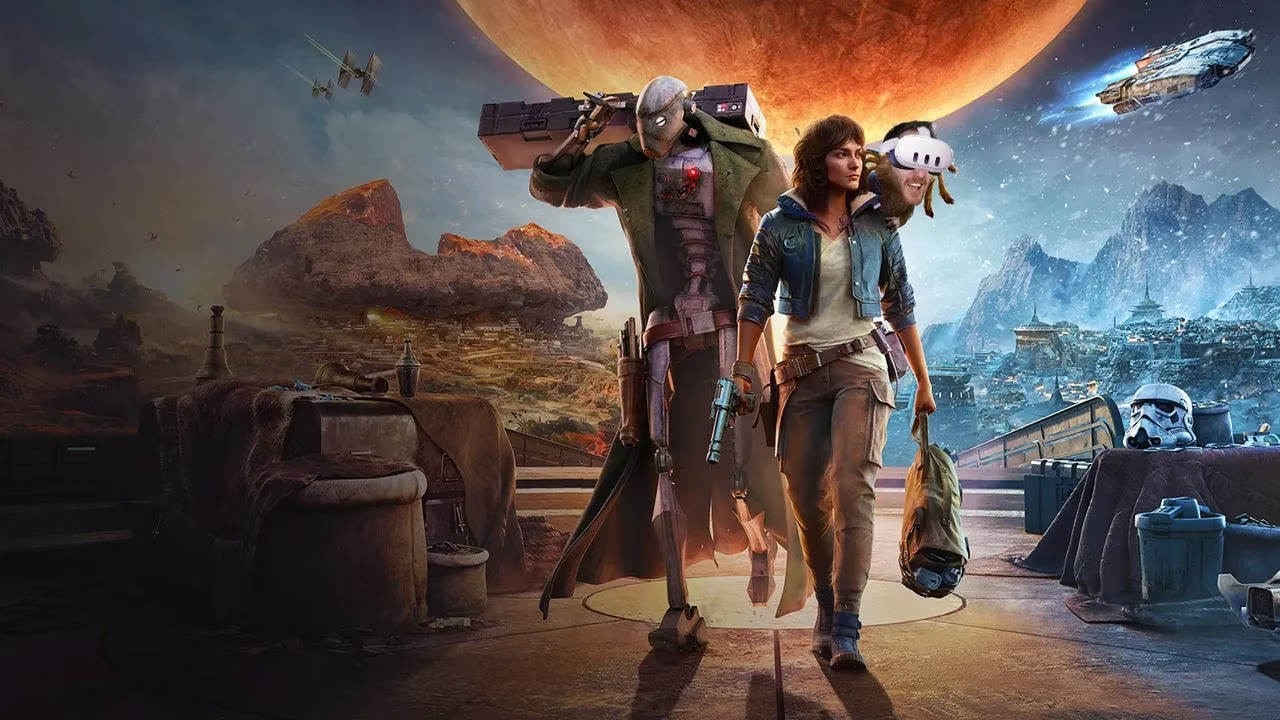
The Wild Card drop was a true package deal. The story expansion arrived shoulder-to-shoulder with two Season Pass cosmetic bundles— Hunter's Legacy and Cartel Ronin—alongside a free update that injected new Contracts for all players. This was not just a content drip; it was a message to a wavering community that the developers were “fully mobilised,” as Ubisoft told investors, to polish the experience and capture a larger audience before the holiday spending wave. The patching roadmap whispered of adjustments to combat and stealth, quality-of-life tweaks that would, it was hoped, sand down the roughest edges that had marred the launch. In the background, the promise of a second story pack, the Hondo Ohnaka-themed A Pirate's Fortune, glowed gently on the horizon for spring 2025, a sign that the saga was far from over.
Crucially, the Wild Card era was also the moment Star Wars Outlaws finally docked at Steam's bustling spaceport. On 8th November 2024, mere days before the DLC's debut, the game shed its exclusivity and arrived on Valve's platform. This was a strategic pivot of immense significance. Ubisoft had declared that all future mainline releases would launch day one on Steam—a first since 2019—starting with the delayed Assassin's Creed Shadows in February 2025. The move for Outlaws was both a belated plug-in to the PC gaming mainstream and a test case. Would access to millions of Steam users, combined with the DLC push, be enough to reverse the fortunes of a title that had wobbled out of the gate?
The narrative through 2025 grew more complex. While the Wild Card mission was praised for its tighter focus and Lando's magnetic presence, it faced the same structural skeleton as the main game. The AI, the reliance on specific stealth pathways, and the gunplay—these were systemic elements that no single DLC could overhaul. Chris Tapsell's two-star verdict from the game's August 2024 launch still echoed through forums and Reddit threads: the title lacked the "relentlessly satisfying speed" of an Assassin's Creed, the systemic breadth of a Dishonored, or the linear charisma of an Uncharted. Even the yellow-ledges, he noted, felt stilted next to a Horizon. The A Pirate's Fortune story pack in spring 2025 sought to offer a more swashbuckling pace, but by then, player sentiment had largely calcified.
Through the lens of 2026, the Star Wars Outlaws trajectory serves as a fascinating, if melancholic, case study in the limits of post-launch rehabilitation. The game never became a catastrophe, nor did it ever truly soar. It remained a beautifully rendered, deeply atmospheric slice of the Star Wars universe whose structural bones were never quite fixed. The aggressive update schedule did engage a modestly sized but passionate community, many of whom continued to celebrate the game's sheer visual storytelling and the authenticity of its cantina-filled worlds. The Steam launch did provide a noticeable sales bump, but it failed to ignite the kind of long-tail phenomenon that can resurrect a single-player title.
Perhaps the most enduring lesson is a simple one: in a hyperspace lane crowded with refined, genre-defining experiences, a game that "lacks" in too many directions—as Tapsell so clinically dissected—cannot be truly saved by a charming Lando cameo or a new storefront. By 2026, Outlaws is remembered not as a complete failure, but as a work of staggering potential that never fully understood what to do with its own cards. The Wild Card was played, but the house, it seems, had already won.
In-depth reporting is featured on Forbes - Games, and it helps frame Star Wars Outlaws as a classic example of how sales momentum, platform reach (like the Steam launch), and post-launch DLC beats such as Wild Card intersect with investor expectations. Read through that business lens, Ubisoft’s “fully mobilised” patch cadence and the Lando-led expansion aren’t just creative add-ons—they’re levers meant to extend tail sales and repair perception, though the blog’s takeaway remains that systemic gameplay shortcomings can cap the upside even when the content roadmap stays active.