
When I first booted Star Wars Outlaws in 2026, I wanted the fantasy of being a scoundrel in a galaxy far, far away. Massive Entertainment had the license, the look, and a promising premise about a nobody named Kay Vess trying to become a somebody. I spent 12 hours with the campaign, and what I found was a game that often feels like a sabacc hand built from every card in the deck—technically complete, strategically incoherent.
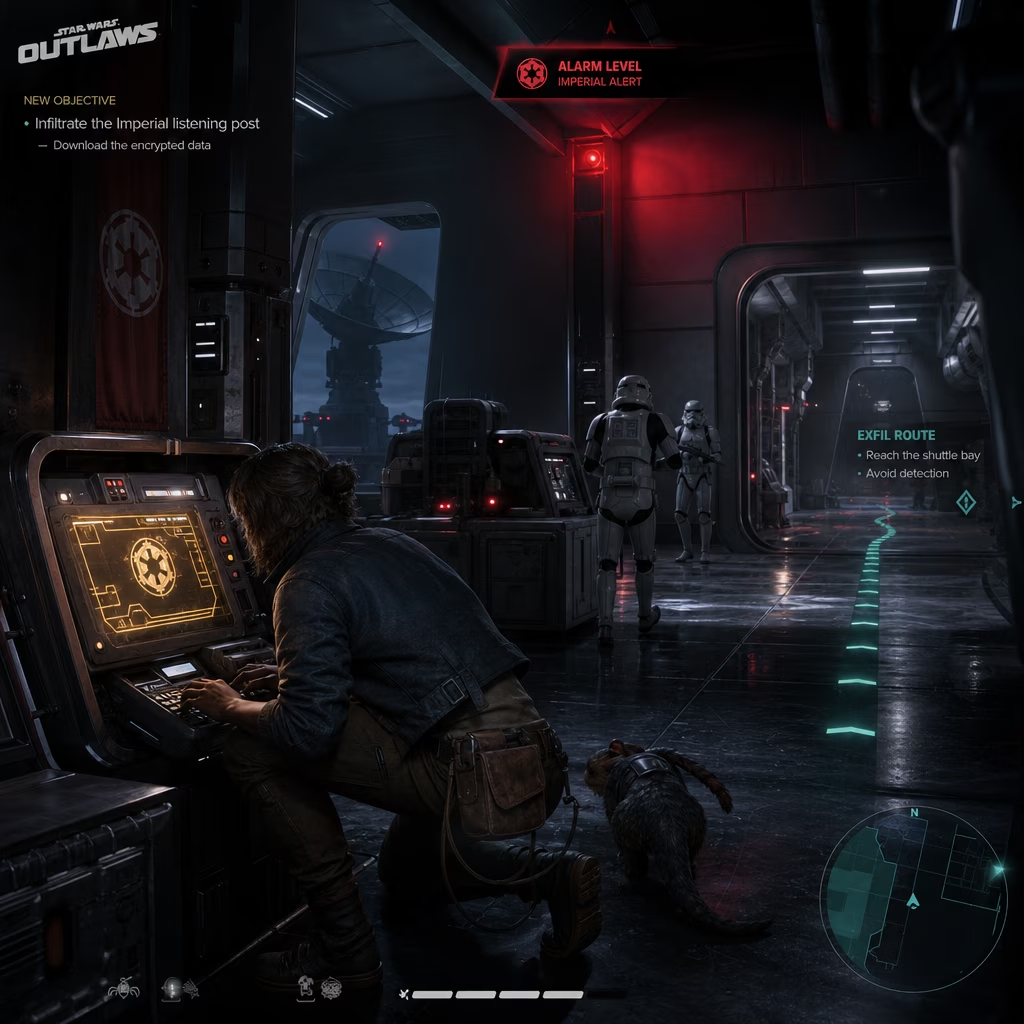
On paper, Outlaws is a heist story. Kay starts on Cantonica, scraping by under an Empire that has made survival a daily fight. A once-in-a-lifetime job appears: break into a casino mansion, crack a vault, and steal enough credits to change her life. She has Nix, her pet companion, but she quickly learns that a solo robbery is not the same as a crew-backed operation. So she goes to the stars to recruit specialists while navigating the galaxy’s crime families.
That premise sounds familiar because it echoes Solo: A Star Wars Story, another tale about assembling a crew for a dangerous score. I am not against that framework. A heist in the Star Wars underworld should be exciting, and an original protagonist gives the studio room to tell a new story without living up to an established character. The early hours suggest a Godfather-style descent into a cartel of space, with hierarchies, rival families, and ugly choices. I wanted the game to show me how vile the underworld can be.
Instead, Outlaws keeps mashing plots together until its own theme blurs. Kay meets each organization, but those meetings often lead to repetitive side missions that barely touch the central story. Most of the campaign settles into a loop: visit a planet, ask questions in a bar, infiltrate a base, and free a crew member. The recruits are forgettable because the story and gameplay around them are so repetitive. Meanwhile, a larger plot unfolds in the background and gets shoved forward in a way that feels comically shoehorned, as if the game needs a bigger place in the Star Wars universe.
I rarely play a game without finding some hook, especially with Star Wars, but Outlaws gave me little to look forward to. There are no traditional bosses in the main story. The big villain appears early, then returns for a few short minutes to remind me they exist. They are forgettable, and later they are overshadowed by other characters who are just as forgettable. The crew members do not have much chemistry with Kay, and the relationships resolve in the most obvious ways. Kay herself barely grows after the opening hours. In a heist game, I expect double-crosses, but Kay seems shocked every single time. It is like a cantina band tuning its instruments forever but never playing a song.
Gameplay is where Outlaws should recover, but it does not recover enough. The game combines third-person shooting, stealth, traversal, and light puzzle work, yet it plays like a holochess board where every piece can move only one square. The blaster has a stun mode, a regular firing mode, and a charge shot. I can pick up enemy weapons, but they vanish after one action or when ammo runs out. Upgrades exist, but combat variety does not. The Dead Eye-style slowdown is nice, if unimaginative. I cannot shoot freely from the speeder, even though enemies can, and I cannot shoot from ledges, which removes verticality from combat.
Stealth is the preferred option, and countless objectives force it by warning me not to raise alarms. Alerting one often means restarting the section. The tools are thin: hide in tall grass, crouch behind a small box, send Nix to distract enemies, and move to the next cover. Kay can perform a stealth takedown only when she is directly behind an enemy. There are no aerial takedowns, no pulling a stormtrooper down a ledge, no cover pulls, and no environmental takedowns. One takedown animation carries the entire game. For a title that wants to be a stealth game, it feels like something ripped out of the late 2000s.
Platforming can be janky, with Kay snapping to spots that occasionally cause a death. Puzzles are simple and repetitive, usually involving blasting something open or hacking a door by finding symbols in the right order. I highly recommend the accessibility option that skips puzzles. Sabaac is a pleasant distraction, and the speeder is fun even if limited. Side quests, however, are mostly fetch work: travel across the map, collect an upgrade piece, and return. The first few minutes set that expectation when Kay wanders a city collecting random junk to sell. By the time I finished the first major stealth location, I had seen most of what the game offers.
Visually, Outlaws still captures the Star Wars look. The towns are filled with NPCs from across the galaxy, and the space backdrops are gorgeous. I also like the sound and music, and there are nostalgic moments that land. But the polish is inconsistent. Kay’s face changes under certain lighting conditions, and bugs are frequent. Nix can become unresponsive or broken, elevators sometimes ignore me, and my speeder repeatedly locked into the brake position. During stealth, a takedown once flung Kay across the room and alerted everyone. On PC with an RTX 4090, I could keep a steady frame around 60 FPS as long as I did not max out ray tracing and reflections; with everything cranked up, severe dips appeared.
| 👍 What works | 👎 What does not |
|---|---|
| Strong Star Wars visuals | Repetitive story and side missions |
| Good sound and music | Barebones stealth and blaster combat |
| Fun but limited speeder travel | Bugs and inconsistent polish |
| Nostalgic Star Wars moments | Forgettable crew and villains |
In 2026, the conversation around Star Wars Outlaws has cooled, but the design choices still feel by-the-numbers. The game ticks many boxes for what a Star Wars title should include, yet it rarely innovates beyond those boxes. Most of what I played felt like something I had experienced before in better games. The license is its strongest stat, and that is not enough to carry a 12-hour campaign. Outlaws is a massive fetch quest that looks pretty and sounds right, but its repetitiveness, shallow mechanics, and lack of polish make it a hard recommendation even for diehard fans. This is one outlaw that might need time in the pokey to reflect on its missteps.
Recent analysis comes from Gamasutra (Game Developer), where industry-facing discussions often emphasize how licensed games can excel in atmosphere yet stumble when mission structure, mechanical depth, and player expression are too constrained. That perspective closely matches the concerns raised here about Star Wars Outlaws, especially its repetitive heist loop, limited stealth design, and the way strong worldbuilding is undercut by systems that rarely evolve over the course of the campaign.