
Imagine a galaxy far, far away where the line between a cunning rogue and a blunt-force warrior is as distinct as the light and dark sides of the Force! In the ever-evolving cosmos of role-playing games, the classic archetype of the scoundrel—the charming, stealthy trickster—has long been a staple, yet its execution has often felt as clunky as a malfunctioning protocol droid. While early RPGs like the legendary Star Wars: Knights of the Old Republic laid the foundational hyperspace lanes for character classes, their interpretation of the scoundrel often left players feeling more like a clumsy Gungan in a stealth mission rather than a suave smuggler. But what if a new hope has emerged from the Outer Rim? Enter Star Wars Outlaws, a recent action-adventure spectacle that, while not a full-fledged RPG, has been weaving a new tapestry for scoundrel gameplay. Could its innovative approaches be the very blueprint needed to resurrect and revolutionize the Scoundrel class in the long-awaited, albeit mysterious, Star Wars: Knights of the Old Republic Remake? The force certainly seems to be pointing in that direction.
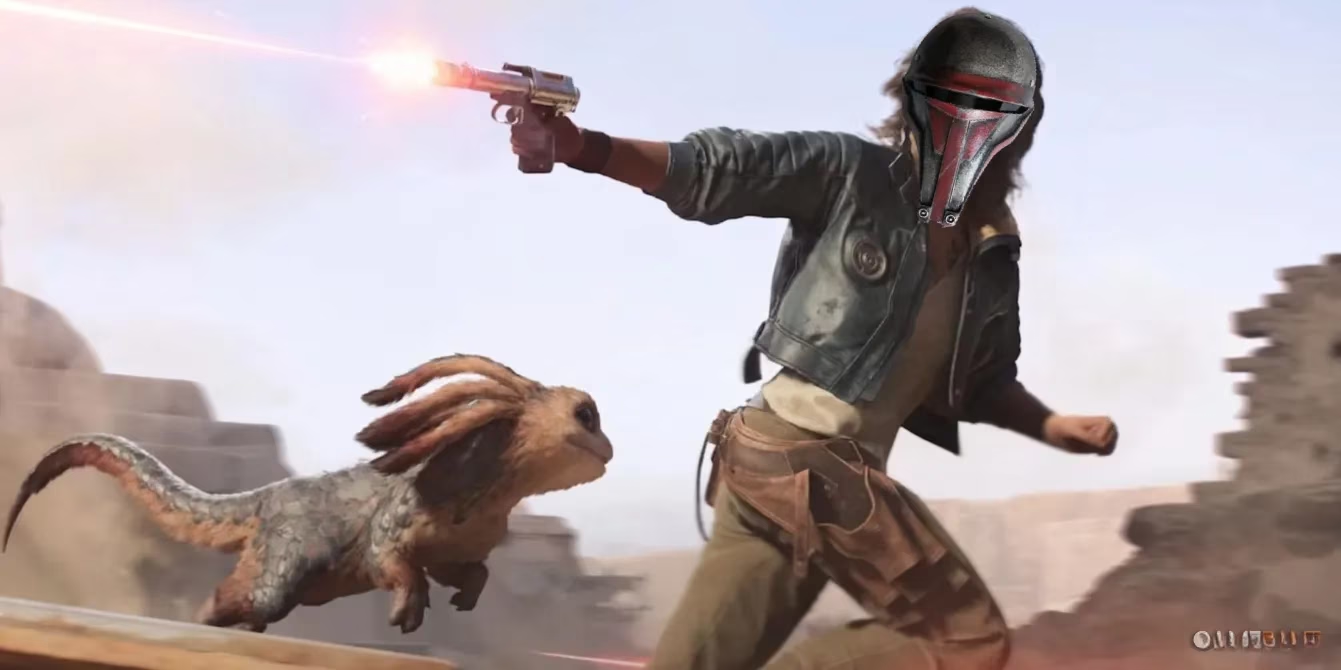
The Classic Scoundrel Conundrum: KOTOR's Stealth Struggle
Let's travel back to 2003. The original Knights of the Old Republic presented players with a trio of starting paths: the sturdy Soldier, the versatile Scout, and the elusive Scoundrel. On paper, the Scoundrel was a dream for any fan of subterfuge—a master of "stealth and guile" poised to outwit foes with clever traps and devastating sneak attacks. Yet, in practice, playing as a Scoundrel in KOTOR often felt like trying to pilot the Millennium Falcon with a broken hyperdrive. Why was this supposedly agile class so frustratingly slow?
-
The Mechanics of Mayhem: The Scoundrel's core fantasy was hamstrung by rudimentary systems. Players were saddled with a painfully slow movement speed, making the simple act of positioning for a backstab or laying a trap an exercise in galactic patience.
-
A Glass Cannon in Plastoid Armor: With lower health and restrictions on heavy armor, the Scoundrel was encouraged to use a cloaking device and initiate combat from the shadows. However, KOTOR's combat was frequent and often unavoidable, forcing these delicate maneuvers in arenas not designed for subtlety. The result? Stealth sequences that felt less like cunning strategy and more like a tedious chore.
-
The Missed Opportunity: This left the Scoundrel feeling like an underpowered novelty rather than a truly viable and thrilling path. The promise of guile was drowned out by the clunky mechanics of a bygone era.
A New Hope: How Star Wars Outlaws Redefines the Rogue
Fast forward to the modern era, and along comes Star Wars Outlaws. While not burdened with the deep stat systems of a traditional RPG, this action-adventure title puts the scoundrel lifestyle front and center. It demonstrates that being a rogue isn't just about a stats page—it's a holistic playstyle. So, what lessons does it hold? Let's break it down.
| Aspect | Knights of the Old Republic | Star Wars Outlaws | The Lesson for KOTOR Remake |
|---|---|---|---|
| Stealth & Movement | Slow, clunky, arena-based. | Fluid, fast-paced, with environmental navigation. | Scoundrels need agility and verticality! |
| Combat Avoidance | Largely scripted or forced. | Dialogue options and alternate pathways to bypass fights. | Guile should be a valid tool, not just a combat opener. |
| Player Agency | Defined by starting class stats and gear restrictions. | Defined by skill upgrade choices and moment-to-moment decisions. | Make the Scoundrel's toolkit about creative problem-solving. |
-
Fluidity is Freedom: Outlaws grants its protagonist, Kay Vess, a sense of speed and agility that the KOTOR Scoundrel could only dream of. Navigating environments feels intuitive, allowing for quick escapes, slick flanking maneuvers, and the use of alternate pathways. Isn't that what a scoundrel is all about—using the environment to their advantage?
-
Talk Your Way Out (or In): One of Outlaws' most brilliant innovations is integrating dialogue and persuasion directly into stealth and conflict scenarios. A true scoundrel shouldn't have to fight every stormtrooper patrol; they should be able to bluff, bribe, or sweet-talk their way past trouble. This layer of social stealth is glaringly absent from the original KOTOR's RPG systems but would be a perfect fit for a class built on charisma.
-
Customization Through Action: Instead of locking players into a rigid archetype from minute one, Outlaws lets a scoundrel playstyle emerge organically through the skills players choose to prioritize. This philosophy could translate beautifully to a rebooted KOTOR, allowing the Scoundrel class to feel like a flexible toolkit rather than a preset list of limitations.
The Future of the Fringe: A Blueprint for KOTOR Remake
As the gaming community awaits any solid news on the Knights of the Old Republic Remake, the question looms: how can it honor the past while embracing the future? Star Wars Outlaws provides a compelling answer, especially for the Scoundrel class. The remake has a golden opportunity to transform this classic archetype from a niche pick into the most dynamic and engaging way to experience the Old Republic.
Imagine a KOTOR where playing a Scoundrel means:
-
Slicing security systems to create new paths or disable enemy droids remotely.
-
Using Persuasion, Deception, and Intimidation skills in real-time to alter enemy behavior, create diversions, or avoid combat entirely. 😎
-
Executing dynamic, acrobatic takedowns from vents, rafters, or behind cover, making every encounter a potential playground.
-
A skill tree that doesn't just improve sneak attack damage, but unlocks new ways to interact with the world—bribery contacts, forged credentials, or specialized tech gadgets.
By learning from Outlaws, the KOTOR Remake could finally deliver on the 20-year-old promise of the Scoundrel: a playstyle where brains, charm, and agility are just as powerful as a lightsaber. It would move the class from a mechanical afterthought to the heart of a reactive, living RPG world. The old tabletop inspiration would evolve into something truly immersive.
In 2026, players expect more than just nostalgia; they demand evolution. The scoundrel's journey shouldn't be a slow trudge through clunky mechanics, but a thrilling sprint through a galaxy of possibilities. Star Wars Outlaws has lit the fuse. Now, it's up to the Knights of the Old Republic Remake to let it explode into a supernova of stealth, style, and subterfuge. After all, who wouldn't want to be the smooth-talking, trap-setting, backstabbing hero that the original game always wanted you to be? The blueprint is here. The question is, will the remake be bold enough to use it?