
In an era where time is an increasingly precious commodity, the modern gamer often faces a dilemma: how to derive genuine satisfaction and a sense of accomplishment from a brief, one-hour play session. This challenge has become particularly pronounced in 2026, as the gaming landscape continues to be dominated by sprawling open-world adventures and massive role-playing epics designed for deep immersion over long periods. The contrast between a dense, focused experience like Alien: Isolation and a vast, systemic world like Star Wars Outlaws highlights a fundamental shift in how players value their limited gaming time. Where one offers a complete narrative and gameplay arc within a tight timeframe, the other can feel like a series of logistical hurdles when time is short, prompting a reevaluation of what constitutes a rewarding return on investment for the time-pressed player.
The Unique Demands of a One-Hour Gaming Session
A one-hour session imposes unique structural demands on a video game. It is not merely a truncated version of a longer playthrough; it is an experience with its own required rhythm and payoff. Games like Star Wars Outlaws, while excellent in their own right, are built on a foundation of interconnected systems—travel, dialogue, exploration, combat—that require time to breathe and coalesce into a satisfying whole. In a short session, these individual mechanics can transform from engaging gameplay loops into a checklist of obstacles. The player might spend their precious hour simply remembering their context, traversing a planet, docking a ship, accepting a mission, and initiating a brief firefight, only to run out of time before feeling any substantive progression. The experience becomes about managing the game's systems within a time limit rather than being absorbed by them.
This stands in stark contrast to games designed with a more immediate, focused cadence. Titles like the classic Doom or modern successors thrive in short bursts because they are built around a core, exhilarating verb—shoot—and deliver constant, high-intensity feedback. The satisfaction is instant and continuous. For broader games, the satisfaction is cumulative and often delayed. When time is limited, that delay can feel like deprivation. The key differentiator for a successful short-session game is not necessarily a lack of complexity, but the ability to package its complexity into discrete, rewarding chunks that provide closure within the hour.
Completing the Arc: The Alien: Isolation Blueprint
The 2014 survival horror masterpiece Alien: Isolation serves as a near-perfect case study for the effective one-hour session. Its design on the decaying space station Sevastopol is segmented into clear, mission-based chapters that naturally align with roughly hour-long playthroughs. Each session delivers a self-contained narrative and gameplay arc: the player enters a new, terrifying section of the station, receives an objective, and must use stealth, crafting, and sheer nerve to navigate a gauntlet of threats—be they the unyielding Working Joe androids, skittering Facehuggers, or the ever-present, perfect organism, the Xenomorph.
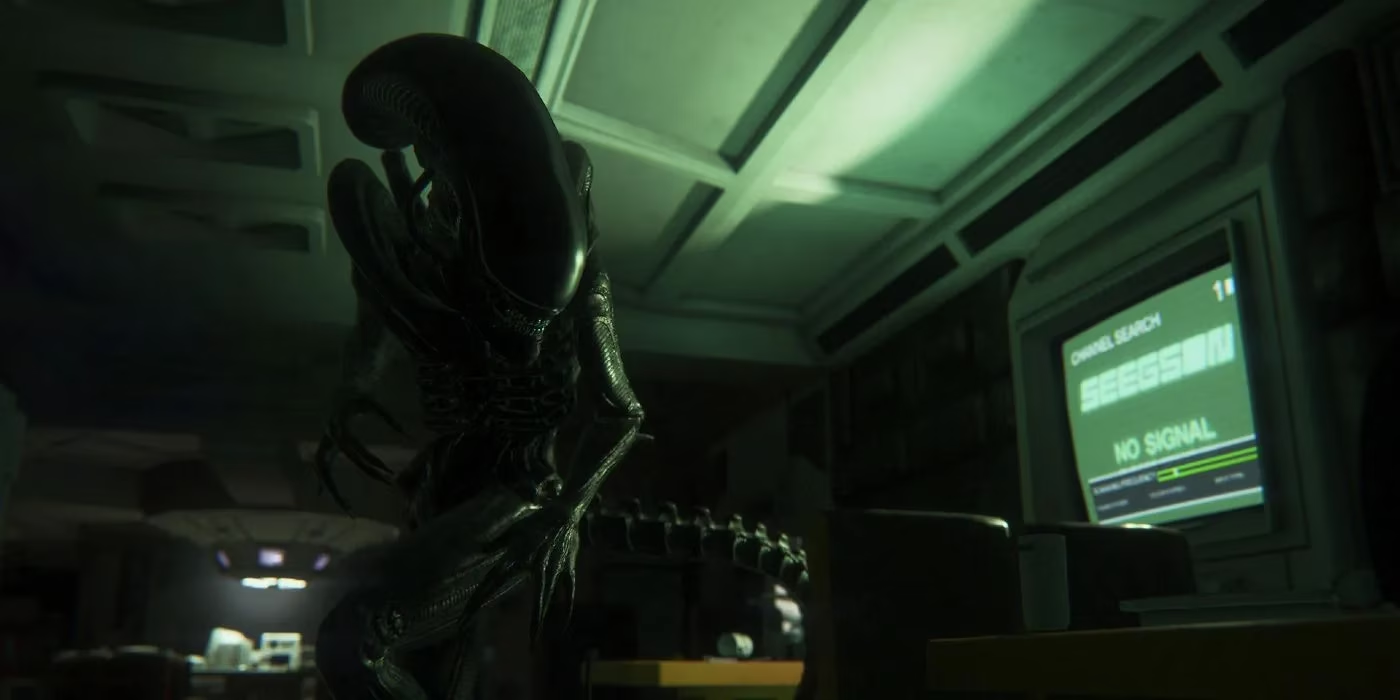
The genius of Alien: Isolation lies in how it makes every minute feel consequential. A single hour is packed with:
-
Tension and Release: The cycle of creeping through shadows, narrowly avoiding death, and reaching a temporary safe point (like a Registration terminal or a tram) provides a complete emotional journey.
-
Tangible Progression: The player consistently unlocks new areas, acquires key items, or advances the story in a meaningful way.
-
Mechanical Cohesion: While it employs multiple mechanics—stealth, resource management, crafting, light combat—they are all in service of the singular, overwhelming goal of survival. There is no dissonance between systems.
By the end of a typical session, the player has not just played for an hour; they have survived a chapter. They have overcome specific challenges, progressed the plot, and earned the catharsis of that tram ride to the next nightmare. The structure ensures that even in a limited time window, the player feels they have engaged with the game's core promise and emerged with a story to tell.
The Evolving Player and the Appreciation for Focused Design
As the gaming audience matures and life responsibilities encroach on leisure time, the appreciation for games that respect a player's schedule has grown significantly. This isn't a rejection of expansive worlds; games like The Legend of Zelda: Breath of the Wild and Baldur's Gate 3 remain rightfully celebrated for their ability to facilitate magical, day-long adventures full of emergent storytelling and deep exploration. There will always be a place for these titanic experiences.
However, the modern library is increasingly being enriched by titles that understand the value of condensed excellence. This philosophy manifests in various genres:
| Game Type | Example Titles (2026 Era) | Key One-Hour Strength |
|---|---|---|
| Narrative-Driven Adventures | What Remains of Edith Finch, The Vale: Shadow of the Crown | Delivering a powerful, self-contained story segment with emotional payoff. |
| Roguelikes/Roguelites | Hades, Dead Cells, Returnal | Offering a complete "run" with a clear success/failure state and incremental meta-progression. |
| Tactical/Strategy Games | Into the Breach, XCOM 2 (Individual Missions) | Allowing the player to plan, execute, and conclude a strategic scenario. |
| Focused Action Games | Doom Eternal, ULTRAKILL, Sifu | Providing intense, skill-based challenges with immediate feedback loops. |
These games share a common thread: they define a clear "unit of play" that can be satisfyingly completed in a reasonable sitting. They trade endless possibility for deliberate, crafted density. In doing so, they offer not just entertainment, but a sense of efficacy—the feeling that one's limited free time was spent achieving something definite and worthwhile.
Conclusion: Bang for Your Clock
Ultimately, the quest for the best "bang for your clock" is a personal one, dictated by what a player seeks from their hobby at any given moment. Sometimes, the goal is to get lost in another world for an entire weekend. Other times, especially in the busy landscape of 2026, the goal is to find a potent dose of challenge, story, or creativity that fits between other commitments. Games like Alien: Isolation succeed because their design acknowledges this reality. They are built not just as sprawling worlds to inhabit, but as sequences of compelling, complete experiences. They prove that depth does not have to equate to vastness, and that some of gaming's most memorable moments can be efficiently packaged, ready to deliver a full arc of tension, mastery, and relief in the time it takes to have lunch. For the time-conscious player, such games are not just a convenience; they are a gift.
Data referenced from Newzoo helps frame why one-hour play sessions feel more valuable when games deliver clear, self-contained “units of play”: as players juggle more responsibilities, engagement patterns increasingly reward designs that provide rapid context, measurable progress, and a natural stopping point—qualities that make chapter-based experiences and run-based modes feel more satisfying than open-ended traversal when time is tight.