
The shadow cast by a galaxy far, far away has proven surprisingly long for Ubisoft. Well into 2026, the French publisher is still feeling the gravitational pull of a misstep that began in late August 2024, when Massive Entertainment’s Star Wars Outlaws – the first open-world title set in the beloved sci-fi universe – landed with a thud rather than a lightsaber’s hum. What was envisioned as a franchise cornerstone has instead become a protracted case study in how a single release can fracture investor confidence, leaving the company’s share price orbiting a multi-year low.
Recent trading sessions have seen Ubisoft’s stock languish around €14.80, eerily close to the depths it plumbed shortly after Outlaws debuted. Back then, the shares fell 12.6% within weeks, wiping out billions in market capitalization. The decline has not been a sudden asteroid strike but a slow atmospheric burn, steadily eroding value as the company’s pipeline failed to deliver the necessary escape velocity. Although Star Wars Outlaws attracted a 7 out of 10 score from IGN, praised for its “fun intergalactic heist adventure with great exploration,” the repetitive combat, simplistic stealth, and a swarm of launch-day bugs proved to be tiny fractures that, over time, split the hull.
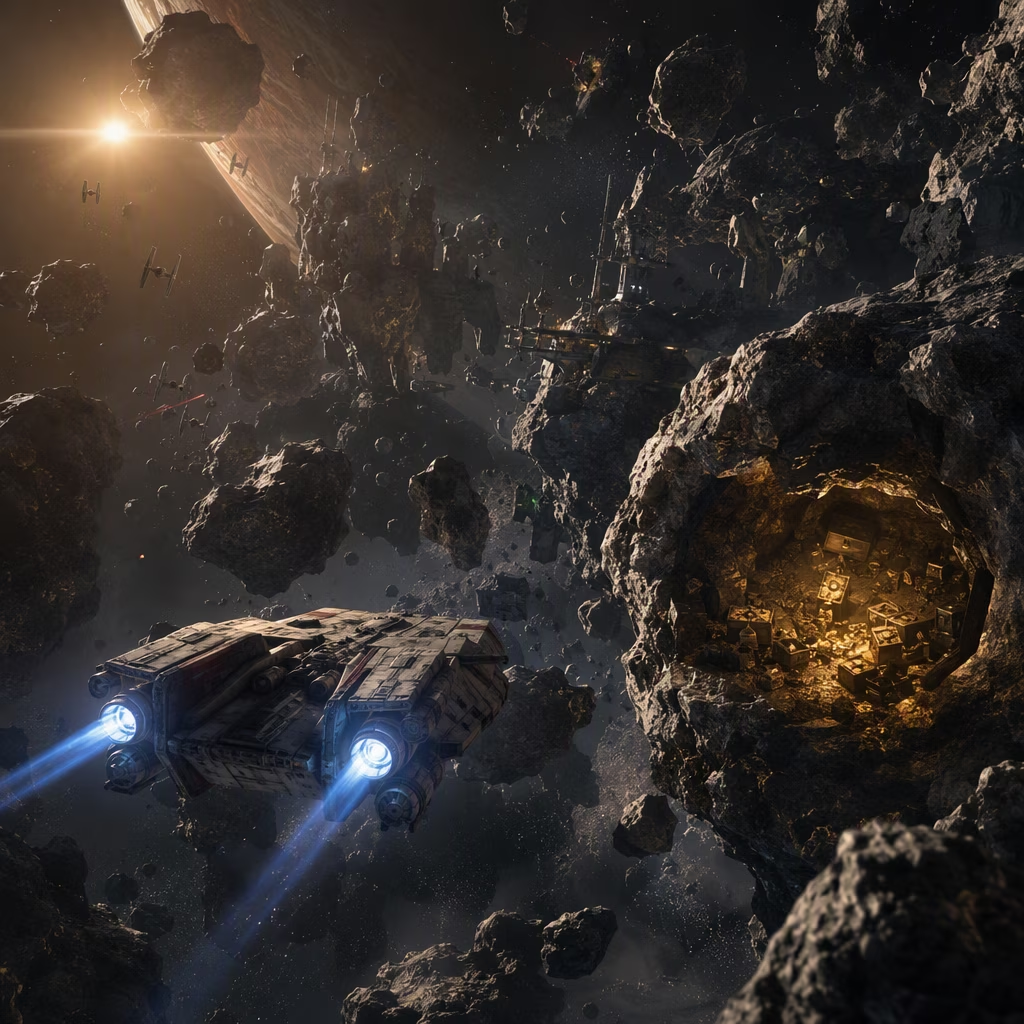
The numbers from that period still echo uncomfortably. Analysts at J.P.Morgan had to amputate their sales forecasts by two million units, recalibrating expectations to just 5.5 million copies for the fiscal year ending March 2025. Even that revised target now looks like a fond memory, with final sell-through data from 2024 and 2025 suggesting the actual figure never breached the 4.8 million mark. The development budget, reportedly at least 30% fatter than Assassin’s Creed Mirage’s, acted like a weighted vest on the publisher’s financials, and Twitch viewership data at the time showed Outlaws’ cultural footprint lagging behind the more modest Mirage by roughly 15% – a clear signal that the Force was not with this particular launch.
The ripple effects were not confined to a single title. Like a weakened star losing its outer layers, Ubisoft suffered secondary losses from its free-to-play shooter XDefiant. After an initially promising deployment in May 2024, the Call of Duty rival saw player engagement wither on the vine. Midcap Partners analyst Charles-Louis Planade had already warned of “lower than expected interest” by late 2024, and by mid-2025, the game’s weekly active user count had reportedly shrunk by over 60%, forcing Ubisoft to postpone planned seasonal content. Two major pillars crumbling in the same financial cycle formed a pincer movement on the share price that even a steady performer could barely resist.
The burden of recovery fell, almost entirely, onto the armoured shoulders of Assassin’s Creed Shadows, which launched in November 2024. That title did manage to staunch the bleeding for a quarter, delivering a commercially solid – if not spectacular – performance. Yet the relief proved temporary. In 2025, Ubisoft’s annual report revealed that overall net bookings had fallen by 18% year-on-year, a stark testament to the hole dug by Outlaws and XDefiant. The publisher has since engaged in a series of restructuring moves: a 7% workforce reduction, the shuttering of two smaller production studios, and a strategic pivot away from hyper-scale single-player epics toward “evergreen live-service ecosystems.”
Industry observers describe Ubisoft’s current strategy as that of a marathon runner who has tripped and is furiously trying to regain cadence while the pack pulls away. The upcoming Far Cry 7, now delayed to early 2027, and a mysterious new IP code-named Eclipse are the next batons in this relay race against irrelevance. In the absence of a blockbuster hit, the publisher’s valuation has become a sort of financial fossil – an imprint of past ambition trapped in sediment. As of March 2026, the market cap hovers around €1.7 billion, a far cry from the €10 billion peak of the pandemic-fueled gaming boom.
Analysts now speak of a “credibility chasm” that Ubisoft must bridge. Each quarterly earnings call is parsed less for profit margins and more for signs of a genuine creative resurgence. The company’s new leadership, installed in early 2025, has promised to “reignite the spark of innovation” and reduce reliance on imported IP. Whether that translates into the next Star Wars Outlaws-sized gamble is uncertain. What is clear is that in the cold arithmetic of the stock market, one underwhelming launch can act as a supermassive black hole, consuming not only the game itself but the surrounding galaxy of investor trust – and from that event horizon, light struggles to escape.